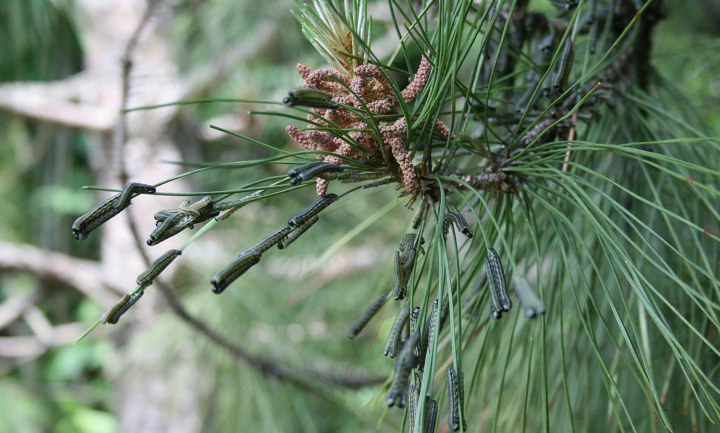
One of our early season “most wanted” for insect and disease control is the European pine sawfly usually found on Mugo, Scots, red, and various other pines. An infestation of these glutinous, greedy little larvae starts as a few stray larvae feeding on an inconspicuous shoot and grows into massive numbers that strip an entire plant of its needles. Although these bugs can cause irreversible damage in a short period of time, with knowledge of the insect’s lifecycle, control can be easy.
Understanding this insect starts by unraveling its somewhat confusing name. When the time comes to control “sawflies,” they’re not flies at all. Sawflies cause real plant damage in their larval stage. They start as tiny larva, no bigger than the tip of a pen, and as they feed off the pine needles they grow to the size of a small earthworm. It is only after they have fed off the plant in their larval stage that they are ready to become actual flies, and at this point the damage has already been done, and it is too late for control.
Sawflies are named for how they lay their eggs. The pine sawfly’s ovipositor is the hollow saw that cuts into the needles, depositing eggs inside the plant. In the fall, a mature sawfly lays eggs inside the needles, and in the spring, the next generation of microscopic larvae begins to grow by eating their way out of the needle. If you look closely at a damaged plant, you can see the oviposition injury and mines of eggs in the needles.
Once the larvae have emerged from the needle, options for control include picking them off by hand, blasting them off with a hose (watch for their likely return), or broadcasting an insecticide over the host plant. Whatever the method, timing is crucial. Sawflies begin to damage plants before they are even noticeable. To make matters even worse, the most readily visible sign of sawfly infestations is plant damage. Often by the time you notice your tree riddled with half-eaten needles and sometimes completely defoliated limbs, it’s time to make plans for next year’s control because the damage is done for this year. As with most insect and disease problems, the key to controlling sawfly damage is a watchful eye and a site-specific pest management program.
We Can Help
Our team of ISA Certified Arborists and Board Certified Master Arborists are standing by to assist with any issues you have with your trees. Contact us today to schedule an assessment of your trees.