Why do trees develop structural problems?
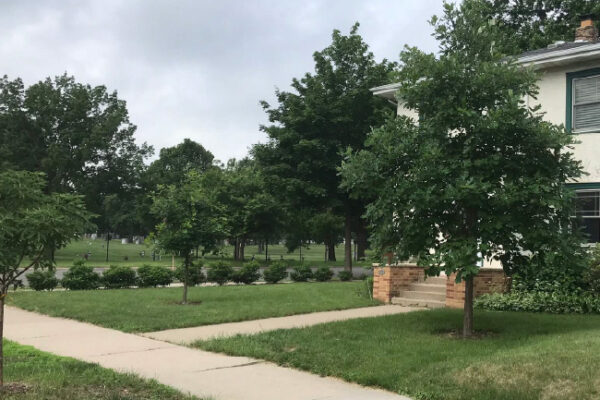
Many of the trees we encounter in our urban landscape evolved in a forested environment. In the forest, trees direct their resources to grow as tall as possible to access limited light. In an urban landscape, trees spread their canopies and grow many lead branches.
When these limbs grow outward, it can lead to stress and breakage at branch unions as the forces increase. Also, certain trees are susceptible to decay, while others tend to form weaker branch unions. Reduction pruning can lower the severity of these issues during storm season.
Proper reduction vs improper practices.
Pruning is necessary to maintain our urban forest. But cuts do wound the tree, so arborists follow specific practices to avoid unnecessary harm. These practices affect how we perform even the smallest cuts. With these in mind, there are some substandard pruning practices. These may have the same aim as reduction pruning but actually create more risk of damage.
Topping and heading cuts.
A heading cut is any cut that leaves behind something too small to sustain future growth. This might occur when someone cuts back to a branch less than one third the size of the removed branch. Or someone might cut somewhere between branches leaving behind a branchless stub. Heading cuts create a higher risk for decay and cause a tree to grow sprouts with weaker attachments. This kind of cut might reduce the leverage on a limb but may introduce other structural issues. It is, however, appropriate on very young trees and shrubs.
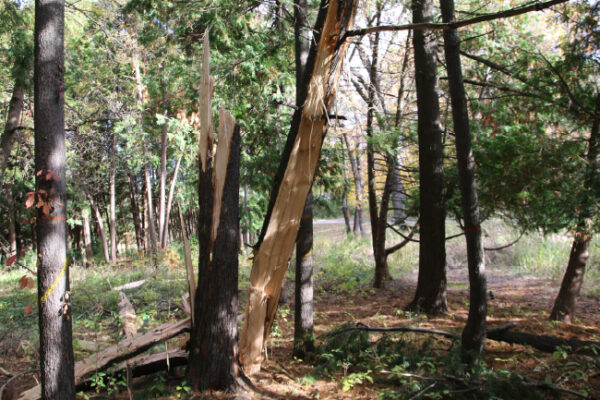
A specific type of heading cut we come across is a topping cut. Topping a tree entails removing its top, cutting back to a smaller limb or a midpoint between limbs. Neither of these options are desirable under normal circumstances. Topped trees have a higher likelihood of trunk decay, which increases the risk of structural failure. The tree will send out waterspouts to compensate for the cut, which will need maintenance to avoid later problems. Sometimes, a severe storm will break off a tree’s top. In that case, a trained arborist can restore the site of that break and minimize later damage.
Lion’s tailing.
Lion’s tailing, also known as thinning, is a process that looks like it sounds. When someone prunes from the interior of the canopy, they leave bare limbs ending in leafy clusters. These limbs can look a lot like a lion’s tail.
The logic behind lion’s tailing is that thinning out interior branches allows wind to move through the canopy. This is actually a misconception. Interior branches and leaves create a dampening effect on the movement of a limb. To over-simplify, these leaves act like small counterweights pulling in different directions. When someone removes these, the leverage on the branch increases. Interior branch growth also helps the branch grow a more tapered shape. A tapered branch will have a stronger union, fortifying it against strong forces.
More aggressive risk mitigation: whole branch removal.
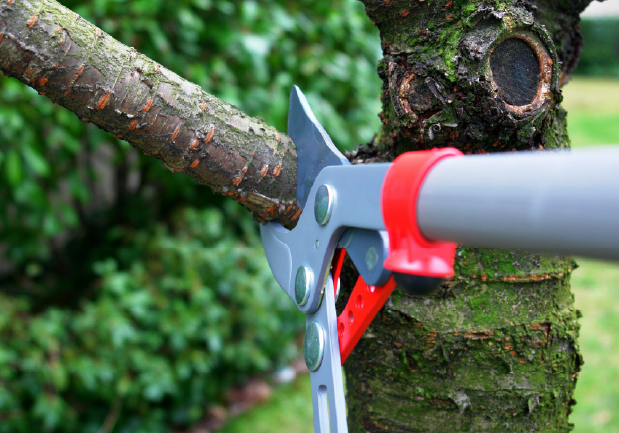
A common response to a high-risk limb is to remove it. Removing a limb ensures it won’t fall on anything, and sometimes this is the course of action we recommend. But, in some cases, removing an entire branch will create a significant wound at the trunk. Many mature trees especially have a hard time closing off larger wounds to decay. A large, unsealed wound can lead to structural problems in the trunk and sometimes death. But reduction pruning entails making many small cuts, of which the tree will have an easier time sealing. If possible, we recommend reduction pruning to lower the risk of limb failure and avoid problematic cuts.
Tree removal.
We love trees and want to preserve them. But we understand the risks a tree can pose to personal property. For trees at risk, removing them may be the only option that eliminates the risk of storm damage. We often recommend low impact pruning or treatment if it makes sense, but sometimes it won’t reduce the risk. If removal is the best option, Vineland’s team of experts can safely remove your tree as well.
Is reduction pruning right for my tree?
Not every tree needs reduction pruning, and it’s not a fail-safe strategy against storm damage. But this is one of many strategic pruning practices that can help you prepare for a stormy summer. To assess whether your tree could use a reduction prune, contact our expert arborists.